

Many new gamblers eventually hear about a famous betting idea that sounds almost magical. The idea is simple. If you lose a bet, you double the next one. If you lose again, you double it again. You keep doubling until you finally win.
At first glance, the plan feels incredibly clever. Many players believe this strategy can guarantee profits. The moment you finally win, you recover every previous loss and still earn a small gain.
This system is widely known as the Martingale betting system. It has been discussed for centuries and is often associated with games like roulette, blackjack, and coin-flip style bets.
But while the system looks safe on paper, real casino mathematics tells a very different story.
To understand why, we need to look closely at how the strategy works, how quickly the bets grow, and why casinos still profit even when players try it.
How the Martingale System Works
The Martingale strategy is built around a simple rule:
- Start with a small bet.
- If you lose, double your next bet.
- Continue doubling after every loss.
- When you finally win, all previous losses are recovered and you gain the value of your original bet.
Here is a simple example starting with a $1 bet.
| Round | Bet | Result | Total Loss So Far |
|---|---|---|---|
| 1 | $1 | Lose | $1 |
| 2 | $2 | Lose | $3 |
| 3 | $4 | Lose | $7 |
| 4 | $8 | Win | Profit $1 |
After losing three times, the player wins the fourth bet. The $8 win covers the previous $7 loss and leaves a $1 profit.
Because of this structure, many players believe the system cannot fail.
However, this belief ignores two important realities: exponential growth and betting limits.
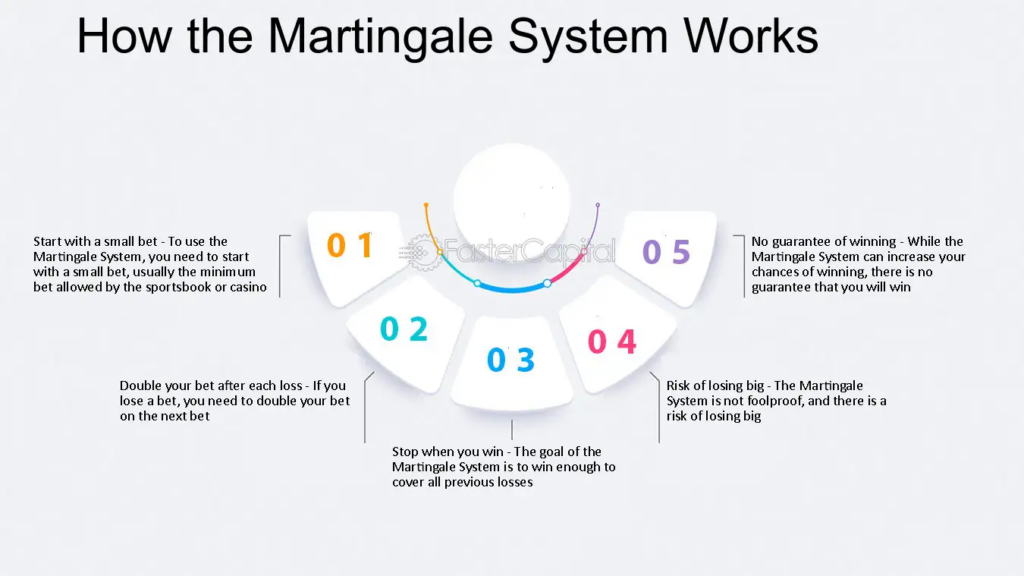
This type of progression shows how quickly bets grow when doubling after every loss.
The Dangerous Speed of Exponential Growth
Doubling bets does not increase slowly. It grows exponentially.
Let us look at what happens during a longer losing streak.
| Loss Number | Bet Size |
|---|---|
| 1 | $1 |
| 2 | $2 |
| 3 | $4 |
| 4 | $8 |
| 5 | $16 |
| 6 | $32 |
| 7 | $64 |
| 8 | $128 |
| 9 | $256 |
| 10 | $512 |
After just 10 losses, the next bet would be $512.
The total money already lost before placing that bet would be $1,023.
And all of that risk is being taken just to earn a $1 profit.
This illustrates the central weakness of the Martingale strategy. A small profit requires an enormous amount of risk.
Probability of Losing Streaks
Many people believe long losing streaks are extremely rare. But probability says otherwise.
Consider a game with roughly 50 percent odds, such as betting red or black in Roulette.
The probability of consecutive losses looks like this:
| Consecutive Losses | Probability |
|---|---|
| 3 losses | 12.5% |
| 5 losses | 3.1% |
| 8 losses | 0.39% |
| 10 losses | 0.097% |
Even though these probabilities seem small, casinos see thousands of bets per day. Over time, losing streaks appear regularly.
In fact, probability theory shows that long streaks are inevitable in random systems.
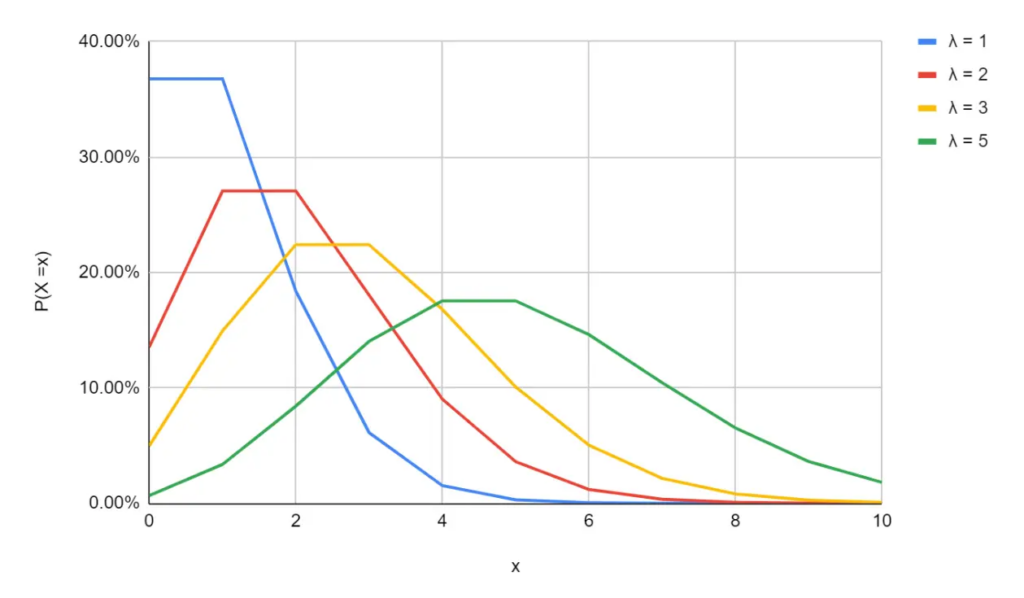
Random events often create clusters and streaks that look surprising to the human mind but are completely normal in mathematics.
The Problem of Table Limits
Casinos are well aware of the Martingale strategy. That is why nearly every casino game includes betting limits.
For example, a roulette table might allow bets from $5 to $500.
Using the Martingale system at this table would look like this:
| Round | Bet |
|---|---|
| 1 | $5 |
| 2 | $10 |
| 3 | $20 |
| 4 | $40 |
| 5 | $80 |
| 6 | $160 |
| 7 | $320 |
| 8 | $640 (Not allowed) |
The system breaks at the eighth round because the next bet exceeds the table maximum.
This limit prevents players from doubling indefinitely, which means the strategy eventually fails during long losing streaks.
Real Casino House Edge Still Applies
Even if table limits did not exist, the house still has a mathematical advantage.
For example, European roulette includes 37 pockets.
| Bet Type | True Odds | Payout | House Edge |
|---|---|---|---|
| Red/Black | 18/37 | 1:1 | 2.7% |
| Single Number | 1/37 | 35:1 | 2.7% |
That 2.7 percent house edge may seem small, but it ensures that casinos profit over large numbers of bets.
The Martingale strategy does not change the house edge. It simply changes how risk is distributed.
Instead of losing small amounts slowly, players risk losing very large amounts suddenly.
What Real Players Say
Many experienced gamblers have experimented with the Martingale system.
One roulette player wrote in an online gambling discussion:
“The system works for hours, sometimes days. Then one streak wipes out everything.”
Another player explained:
“I made small profits all night doubling bets. Then I hit nine losses in a row and my entire bankroll disappeared.”
Professional gambling author Ed Thorp, known for pioneering blackjack card counting research, once explained a key truth about betting systems:
“No betting progression can overcome a negative expectation game.”
In other words, if the odds favor the casino, changing your bet size cannot eliminate that disadvantage.
Why the Strategy Feels Like It Works
The Martingale system creates a powerful psychological illusion.
Most sessions end with small profits. A player might win $1 repeatedly across many rounds.
This creates the impression that the strategy is reliable.
But eventually a long losing streak arrives.
When that happens, all the small profits from earlier sessions can disappear in a single moment.
This pattern is sometimes described as:
“Many small wins followed by one very large loss.”
Behavioral economists often compare this structure to financial risk strategies that hide danger until rare events occur.
Example of a Bankroll Collapse
Imagine a player with a $1,000 bankroll starting with a $5 bet.
Here is what happens during a losing streak:
| Loss Number | Bet | Total Lost |
|---|---|---|
| 1 | $5 | $5 |
| 2 | $10 | $15 |
| 3 | $20 | $35 |
| 4 | $40 | $75 |
| 5 | $80 | $155 |
| 6 | $160 | $315 |
| 7 | $320 | $635 |
| 8 | $640 | $1,275 |
By the eighth loss, the player has already exceeded their bankroll.
And remember, this entire risk was taken just to win $5.
Why Casinos Are Not Afraid of the Martingale
Casinos are comfortable with players using the Martingale strategy for three main reasons:
- Table limits stop infinite doubling
- Players have limited bankrolls
- The house edge remains unchanged
Because of these factors, the strategy does not threaten casino profits.
In fact, some casinos quietly welcome it because it increases bet sizes quickly.
The Final Reality
The Martingale betting system is fascinating because it looks logical at first glance. The math seems to promise guaranteed recovery after losses.
But real probability and casino rules reveal its weakness.
Doubling bets causes risk to grow far faster than most players expect. Eventually a losing streak appears that is too long for the bankroll or table limits to handle.
The strategy can produce many small wins, but the rare losses are extremely large.
In the end, the core rule of gambling remains unchanged.
Changing the size of your bets cannot change the underlying probabilities.
Chance continues to follow its own quiet rules, no matter how cleverly a player tries to chase it.